
Solo vs. Team Driving: Explore pay math, mileage caps, and cab life trade-offs to decide which driving style fits your career at TRANSGEORGIA
Every driver who's spent a few years behind the wheel eventually asks the same question: would I make more money, and be happier, running as a team instead of solo? The honest answer is that team driving usually pays more — sometimes significantly more — but the trade-off isn't really about money at all. It's about whether you can share a 60-square-foot cab with another person for days at a stretch and still want to talk to them at the end of the week.
What Solo Driving Actually Looks Like
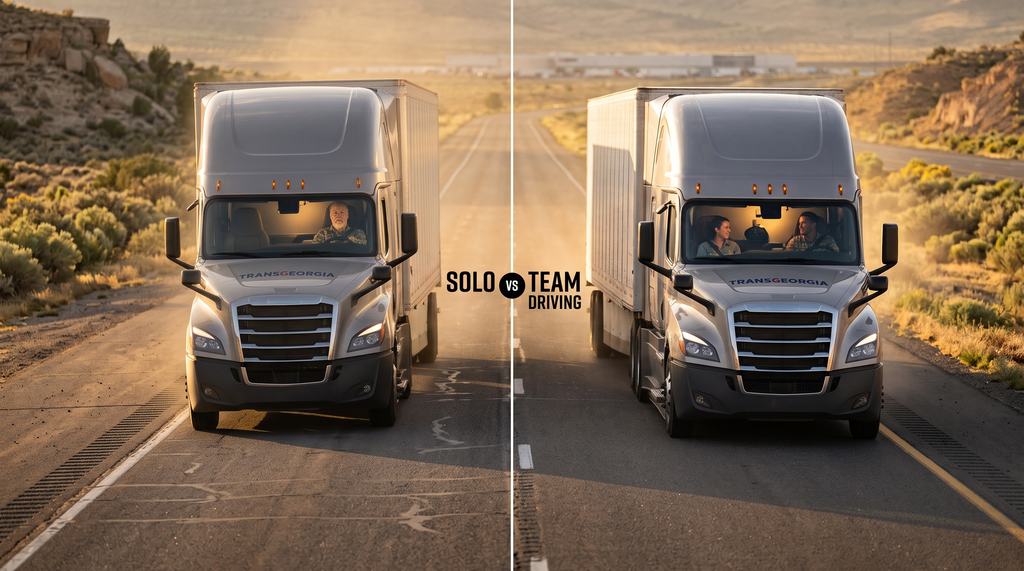
Solo drivers run the truck alone, which means driving time is capped by federal hours-of-service rules — generally 11 hours of driving within a 14-hour on-duty window, followed by a mandatory rest period. That ceiling limits how many miles one driver can cover in a week, typically landing in the 2,500 to 3,000 mile range. In exchange, solo driving offers something team driving can't: full control. You set your own pace, choose your own music, and answer to no one else's schedule or habits in the cab. Solo routes also come in more flavors — local, regional, or long-haul — giving drivers a real choice between daily home time and being out for stretches at a time.
What Team Driving Actually Looks Like
Team driving pairs two drivers — often spouses, siblings, or close friends — in the same truck, alternating who's behind the wheel while the other rests in the sleeper berth. Because one driver can legally be resting while the other drives, a team truck rarely has to stop moving except for fuel, inspections, and loading or unloading. That's the entire economic logic of team driving: the truck becomes a nearly continuous asset instead of one that sits still for 10 hours every night. Teams typically cover 4,500 to 6,000+ miles a week — roughly double what a solo driver runs — and they tend to get first pick of time-sensitive, high-priority freight precisely because they can guarantee faster transit.
The Pay Comparison
At TRANSGEORGIA, our own numbers give a concrete answer to "how much does this actually pay." Solo drivers earn $2,000 per week — annualized over a standard 52-week year, that's $104,000. Team trucks earn $3,500–$4,000 per week total, split between the two drivers, which works out to roughly $1,750–$2,000 per driver each week, or an annualized $91,000–$104,000 per driver.

The practical takeaway: at TRANSGEORGIA, team driving isn't about chasing a bigger individual paycheck than solo — it's about the mileage, the lifestyle, and the freight. Teams cover nearly double the miles of a solo run, get first pick of time-sensitive, high-priority loads, and keep the truck moving almost around the clock instead of parked overnight. If that's the kind of driving you want, our doors are open — TRANSGEORGIA is actively recruiting team drivers.
Why HOS Rules Are the Whole Story
The pay math ultimately comes down to one regulatory fact: a solo driver's truck is legally required to sit idle once that driver hits their Hours-of-Service (HOS) limit, whereas a team's truck rarely stops moving because the second driver takes over the wheel.
Over a full week, that regulatory difference compounds into thousands of additional miles moved by the truck. This continuous asset utilization is precisely why total team revenue outpaces solo revenue industry-wide, and why teams get first pick of high-priority, time-sensitive freight.
What each driver individually takes home from that extra revenue, however, depends entirely on how a carrier structures and splits team pay between its two drivers. This distribution model is why the per-driver earning gap can look significantly different from one carrier to the next — TRANSGEORGIA included.
Which One Actually Fits You?
If you value independence, want total control over your schedule, and prefer not to share a small space with another person for days at a time, solo driving is very likely your best fit—and at TRANSGEORGIA, it comes with pay that is fully competitive with team driving, not a consolation prize.
If you are comfortable running with a partner—a spouse, a sibling, or a longtime friend—and you value near-continuous mileage, priority freight, and shared cab responsibilities, team driving provides a strong, practical option.
Neither mode is objectively superior, and at TRANSGEORGIA specifically, neither is a automatic financial winner on a per-driver basis. The drivers who thrive long-term are those who are honest with themselves about which trade-off—companionship and constant motion, or independence and personal space—they actually want to live with every day on the road.