
Dry van or power only — which truckload mode actually fits your freight?
Shippers evaluating truckload capacity eventually run into the same fork in the road: dry van vs. power only shipping. While both freight modes move identical non-temperature-controlled goods, they distribute asset ownership, dock efficiency, and risk completely differently. Picking the wrong capacity type quietly erodes a logistics budget over a year of loads. The decision ultimately comes down to a single distinction: are you paying for space on wheels, or are you just paying for the engine?
What Dry Van FTL Actually Is
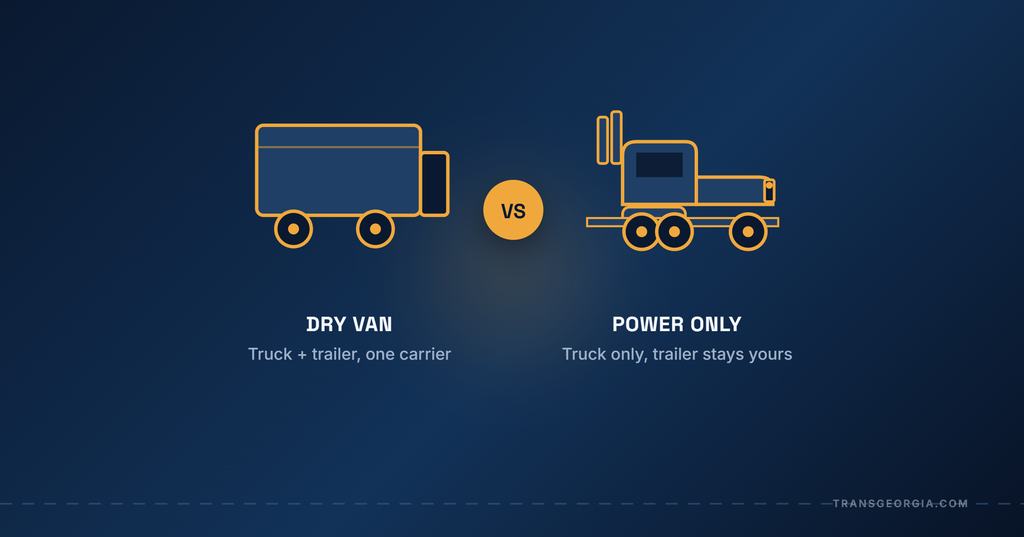
Dry van full truckload (FTL) service moves freight in an enclosed 48' or 53' trailer as a single dedicated load from origin to destination. Because the carrier supplies both the tractor and the trailer as one complete unit, dry van FTL shipping remains the default choice for general freight across North America.
A standard 53-foot dry van trailer accommodates approximately 26 standard pallets (48" x 40") and up to 44,000 pounds of payload. With interior dimensions averaging 100 inches wide by 110 inches high, it provides ample capacity for boxed retail merchandise, packaged consumer goods, shelf-stable food, and non-perishable industrial products.
Because one carrier owns and operates the entire rig, dry van capacity is operationally seamless: you book a load, the driver arrives with a trailer attached, loads at your dock, hauls direct, and delivers — no intermediate stops or trailer swaps required. This turn-key simplicity is dry van's core value proposition, making it the ideal freight mode for shippers with variable volumes, limited dock space, or an preference to outsource trailer asset management to the carrier.
What Power Only Actually Is {#what-power-only-actually-is}
Power-only shipping decouples the tractor from the trailer. In a power-only freight arrangement, the carrier provides only the driver and the tractor (the "power unit") to pull an enclosed trailer, flatbed, or chassis that belongs to — or is leased by — the shipper, receiver, or a third-party logistics provider (3PL).
This separation is what enables high-efficiency drop-and-hook operations. Rather than sitting through a multi-hour live load, a driver arrives at your facility, drops an incoming trailer, hooks up to an already-loaded trailer, and departs within minutes. For high-volume shippers running consistent freight lanes, eliminating loading dock dwell time is the primary advantage of power-only capacity. Major asset-based carriers and 3PLs run large power-only networks specifically to provide this agility while maintaining centralized carrier vetting, freight tracking, and insurance coverage.
Because the carrier isn't absorbing trailer financing, routine maintenance, or physical damage insurance on the box itself, power only structurally removes a layer of fixed equipment overhead from the carrier side. However, those cost savings only translate to your bottom line if your facility has the yard space, trailer inventory, and volume to fully leverage drop-and-hook flexibility.
The Real Difference: Who Owns the Trailer Problem
Every operational divergence between these two modes traces back to asset control and equipment upkeep. In standard dry van shipping, the carrier owns the asset problem entirely—bearing total financial and legal responsibility for routine maintenance, DOT inspections, tire wear, and roadside repairs. If a brake fails or a tire blows out, it is strictly the carrier's issue to resolve, keeping shippers completely insulated from maintenance logistics.
Power only flips this balance, making maintenance obligations variable and heavily dependent on specific customer or brokerage policies. Because drivers hook up to unfamiliar trailers owned by shippers, leasing companies, or 3PL trailer pools, brokers enforce strict verification protocols: drivers must photograph all four sides of the trailer and inspect every tire before pickup and after drop-off.
This asset split creates a sharp divide in liability and daily operations:
- Pre-Existing Defects: If a inspection uncovers pre-existing damage, flat tires, or safety violations prior to dispatch, the trailer owner is legally responsible for sending a repair crew to fix it.
- In-Transit Issues: Once the trailer hits the highway, any unexpected breakdown becomes the power-only carrier’s responsibility to manage on the road.
For power-only drivers swapping unfamiliar trailers daily, these inspection hurdles introduce constant friction. Finding a defect at the dock halts dispatch until a service truck arrives, leading to unexpected pickup delays, missed delivery windows, and operational headaches that standard dry van shipments simply avoid.
Transitioning from dry van FTL to a power-only network requires specific operational setup. To make power only cost-effective, your supply chain generally needs:
- Trailer Assets or Leasing Agreements: Access to owned trailers, leased equipment, or third-party trailer pools.
- Staging Infrastructure: A dedicated drop lot, staging yard, or sufficient dock space where trailers can sit uncoupled between moves.
- High-Volume Lane Consistency: Regular, predictable freight lanes that justify the operational overhead of tracking and managing empty trailers.
For a shipper moving one or two loads a week across irregular routes, dry van’s all-in simplicity is the clear winner. However, for high-volume distribution centers running consistent daily lanes, power-only drop-and-hook operations eliminate loading dock bottlenecks and turn drivers around in minutes rather than hours.
Which One Should You Choose?
For most shippers moving occasional or inconsistent freight, standard dry van FTL remains the more practical choice. It requires no trailer investment, no yard space, and no additional coordination layer — you're paying a bit more per mile in exchange for a carrier that owns the entire problem end to end.
Power only earns its keep when a few conditions line up at once: you're shipping consistent volume on repeatable lanes, you have (or can lease) trailers and a place to stage them, and you're either trying to scale capacity quickly during a demand surge or trying to squeeze detention and turnaround time out of a high-frequency route. Warehouse relocations, seasonal peaks, and cross-border moves are also common use cases where the flexibility of decoupled trailers outweighs the added coordination.
The practical test is simple: if managing trailers sounds like a chore, dry van is the right answer. If managing trailers sounds like an opportunity to cut idle time and detention costs out of a lane you already run every week, power only is worth building into your routing guide.
- What is Power Only trucking & how does it work? — Schneider
- Dry Van Full Truckload (FTL) Shipping — First Call Logistics
- What Is Power Only Trucking? (+How 3PLs Can Help You Use It) — RXO
- Power Only Trucking — Truckstop
- What Is Power Only Trucking Loads, Rates and How It Works — Datatruck