
Preparing for a better trucking insurance quote starts before renewal
For a motor carrier, insurance is not simply another annual expense. It can determine which freight you can haul, which brokers will work with you, how much risk your company can survive, and in some cases whether the business can continue operating after a serious accident.
Yet many carriers approach insurance backward. They wait until a policy is close to expiration, send the same information to several agents, compare the final premium numbers, and choose the cheapest quote. That can be an expensive mistake.
The real question is not: “Who gave us the cheapest insurance?”
It is: “What exactly are we buying, who is standing behind it, what risks are excluded, and will this policy actually protect our operation when something goes wrong?”
At TRANSGEORGIA, our experience operating in the U.S. trucking market has taught us that insurance should be treated as a year-round risk-management project — not a once-a-year purchasing decision.
This guide explains what carriers should consider before choosing an insurance partner.
The Federal Minimum Is Not Necessarily the Practical Minimum
One of the first distinctions a carrier must understand is the difference between: what the government requires and what the freight market requires.
For a for-hire interstate property carrier operating vehicles with a GVWR of 10,001 pounds or more and transporting non-hazardous property, the federal minimum level of financial responsibility is generally $750,000.
Certain hazardous-material operations require $1 million or $5 million, depending on the commodity and method of transportation.
FMCSA also makes an important distinction regarding cargo insurance: federal cargo-insurance filing requirements are not generally imposed on ordinary non-household-goods property carriers in the same manner as public-liability requirements.
But meeting FMCSA's minimum does not mean that a carrier is adequately insured for the commercial freight market. Major brokers commonly require more.
For example, C.H. Robinson currently lists:
- $1,000,000 automobile liability
- $100,000 cargo liability
as standard carrier requirements. TQL likewise lists a minimum of $1 million auto liability and $100,000 cargo, and specifically requires reefer-breakdown coverage when applicable.
Arrive Logistics' published contractual requirements go further in some areas, including $1 million auto liability, $100,000 motor-truck cargo liability and other required coverages.
That creates an important lesson:
Legal minimum coverage can keep your authority compliant. Commercially adequate coverage helps keep your trucks loaded.
A carrier should therefore build its insurance program around its actual customers, equipment, commodities and contracts, not around the lowest number legally permitted.
Different Equipment Creates Different Insurance Risks

There is no universal insurance package that fits every trucking company.
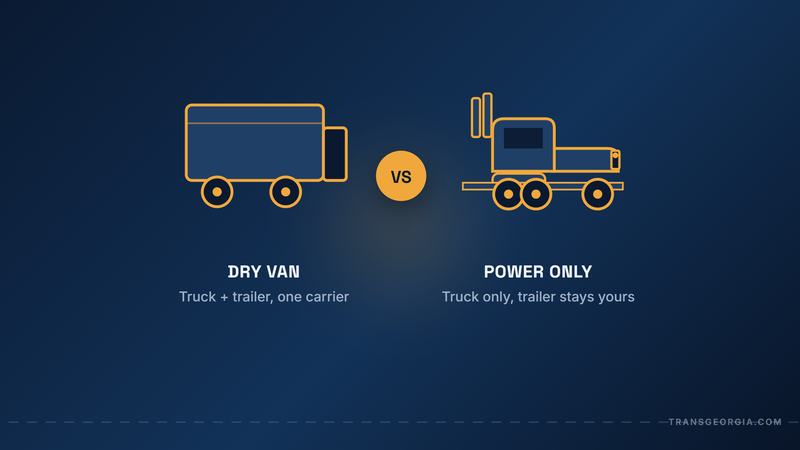
A dry-van carrier, refrigerated carrier, flatbed operation and expedited carrier may all have $1 million of auto liability, yet their real exposure can be dramatically different.
Dry Van
A typical dry-van operation should evaluate at least:
Auto Liability
Protects against covered bodily injury and property-damage liability arising from operation of insured vehicles.
Motor Truck Cargo
Protects against covered loss or damage to cargo in the carrier's custody.
Physical Damage
Protects the carrier's owned or financed equipment, generally through collision and comprehensive or specified-perils coverage depending on the policy.
General Liability
Can address certain business liabilities outside the direct operation of the truck, subject to policy terms.
Trailer Interchange
Important when a carrier takes possession of trailers owned by other parties under a trailer-interchange agreement.
Non-Owned Trailer / Trailer Physical Damage
Depending on the operation and policy structure, protection may be needed when using trailers the carrier does not own.
Workers' Compensation / Occupational Accident
The appropriate structure depends on the company's workforce, state law and employment arrangements.
Umbrella or Excess Liability
Can provide limits above the underlying liability policy.
A $100,000 cargo policy may satisfy many broker requirements, but that does not automatically make $100,000 sufficient.
If you regularly haul $180,000, $250,000 or $500,000 shipments, the carrier needs to understand exactly what happens above its cargo-policy limit.
Refrigerated Freight Requires Another Layer of Protection
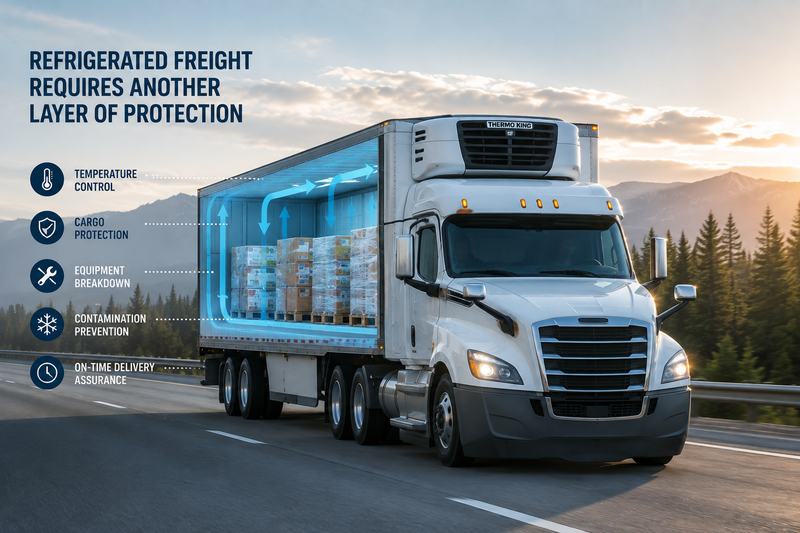
Reefer operators face risks that dry-van operators do not. Imagine a $150,000 refrigerated shipment. The trailer remains physically intact. There is no collision and no theft. Instead, the refrigeration system fails. The temperature rises outside the required range and the entire shipment is rejected.
A carrier that purchased cargo insurance without properly addressing refrigeration-related exposure may discover that the policy it thought protected the load does not respond as expected.
Reefer carriers should therefore specifically discuss:
- refrigeration breakdown;
- temperature-change coverage;
- equipment failure;
- spoilage;
- contamination;
- unattended vehicle provisions;
- reefer maintenance requirements;
- temperature-record requirements;
- exclusions for improper temperature settings; and
- limits or sublimits applicable to perishable commodities.
This is not merely theoretical. TQL, for example, explicitly states that Reefer Breakdown must appear on the insurance certificate when applicable for carriers hauling its freight.
The lesson is simple: Do not ask only whether you have cargo insurance. Ask what events your cargo policy actually covers.
Open-Deck Carriers Need to Think Beyond the Cargo Limit
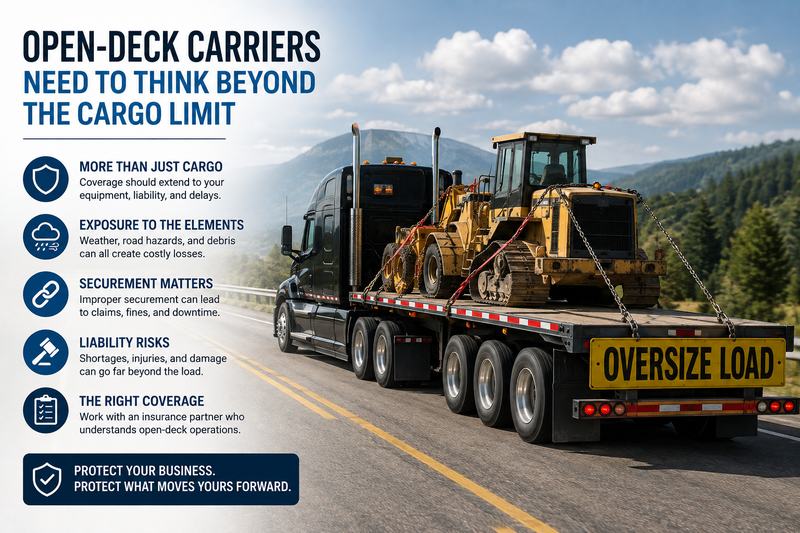
Open-deck operations such as flatbed and step-deck transportation create insurance exposures that can be significantly different from standard dry-van freight. These carriers frequently transport machinery, steel, construction materials, oversized equipment, and other high-value commodities that remain exposed to weather and require specialized loading and securement procedures. As a result, carriers should look beyond the cargo limit shown on the insurance certificate and carefully evaluate how the policy responds to their actual operations.
Load securement is particularly important for open-deck carriers. Chains, straps, tarps, loading and unloading procedures, and in some cases crane-related operations can introduce additional risks. Weather exposure is another consideration, especially when transporting commodities that can be damaged by rain, moisture, or other environmental conditions. High-value or oversized shipments may also exceed the standard cargo limits provided by a carrier's policy.
Most importantly, having a high cargo limit does not necessarily mean every commodity is fully protected. Policies may contain exclusions, restrictions, or sublimits for certain types of freight. A carrier with $250,000 in cargo coverage could actually have less meaningful protection than a carrier with a lower limit if the policy excludes or restricts the commodities it regularly transports. For open-deck carriers, the goal should therefore be to ensure that the insurance policy matches the actual freight, values, equipment, and operating practices of the business, rather than choosing coverage based solely on the dollar amount printed next to “Cargo Limit.”
Expedited Carriers Have Their Own Insurance Problem

Some vehicles may fall below the weight thresholds that apply to traditional Class 8 trucking, which makes it especially dangerous to assume that the carrier's legal minimum and the customer's contractual requirement are identical.
FMCSA's financial-responsibility rules differ depending on vehicle weight, commodity and operating circumstances.
Meanwhile, the shipper or broker can impose insurance requirements substantially higher than the regulatory minimum.
Expedited carriers should therefore build insurance around the freight they intend to access, not merely around vehicle size.
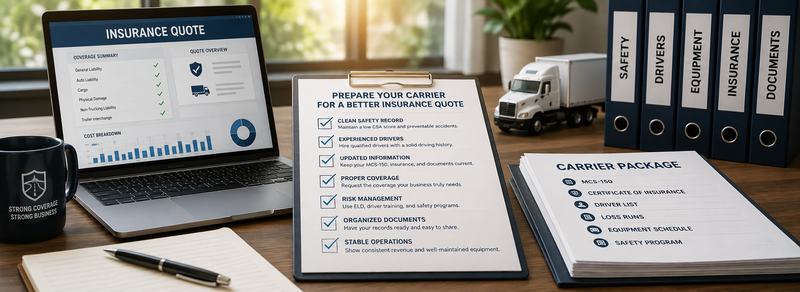
How to Prepare Your Carrier for a Better Insurance Quote
A successful insurance renewal should begin long before the current policy expires. For many carriers, starting the process approximately 60–90 days before renewal provides enough time to review the operation, correct inaccurate information, collect documents, and approach the insurance market in an organized way. Waiting until the final weeks can limit options and put the carrier in a weaker negotiating position.
An insurance application should be treated as a presentation of the company to the underwriter, not simply as paperwork required to receive a price. Before requesting quotes, carriers should review their driver and equipment schedules, loss runs, MVRs, operating radius, actual garaging locations, commodities, annual mileage, equipment values, safety procedures, and other information that describes how the company operates. The objective is to give the underwriter an accurate and complete picture of the business.
Claims history is an important part of that picture, but a loss run does not always tell the entire story. A claim may show a large dollar amount without explaining the circumstances surrounding the accident. When appropriate, carriers should be prepared to explain what happened, whether the accident was preventable, what ultimately happened with the claim, and what corrective measures were introduced afterward. If a driver was retrained, a safety policy was changed, cameras were installed, or a maintenance procedure was improved, that information can help demonstrate that management learned from the event and took action to reduce the chance of recurrence.
Driver quality is another major part of the carrier's risk profile. A new tractor equipped with the latest technology cannot compensate for weak hiring standards. Driving experience, MVR history, accidents, serious violations, license status, and the company's overall driver-selection process can all influence how an insurer evaluates an operation. This is why insurance considerations should begin before a driver is hired, rather than after the driver has already been placed behind the wheel.
Carriers employing non-domiciled CDL drivers should be particularly careful not to rely on assumptions or general statements about insurability. Insurance companies can have different underwriting guidelines, documentation requirements, eligibility standards, and pricing approaches. A driver who is acceptable to one insurer may be treated differently by another. Before expanding the driver pool, carriers should discuss their hiring plans with an experienced trucking insurance agent and understand how the specific insurer evaluates those drivers.
The carrier's location and operating territory can also affect underwriting. Actual garaging locations, states of operation, operating radius, traffic exposure, local loss experience, state insurance requirements, and the legal environment can all form part of an insurer's risk evaluation. For this reason, carriers operating similar equipment with similar driver counts can still receive very different insurance quotes.
However, carriers should never attempt to reduce premiums by providing an address, garaging location, mileage, operating radius, driver information, or other details that do not accurately represent the operation. There is an important difference between legitimately structuring a business efficiently and misrepresenting a risk to an insurance company. A lower premium is not a savings if inaccurate information later creates a coverage dispute or other serious problem.
The most sustainable opportunity to control insurance costs is therefore to make the company itself a better risk to insure. Strong driver-selection standards, regular MVR reviews, preventive maintenance, documented safety policies, accident investigations, driver coaching, and effective claims management can strengthen a carrier's underwriting profile over time. Instead of asking only, “Which insurance company is cheaper?” management should also ask, “What can we improve during the next twelve months to make more insurers interested in our business?”
Technology is increasingly becoming part of that strategy. Dash cameras, ELD information, GPS and telematics systems can provide valuable insight into behaviors such as speeding, harsh braking, following distance, seat-belt use, and other safety events. Camera footage can also become extremely valuable after an accident by helping establish what actually occurred rather than relying entirely on conflicting accounts.
Simply installing technology, however, is not enough. The stronger story is when a carrier can demonstrate that management uses the information. A safety event should lead to review, driver coaching when necessary, documented corrective action, and follow-up. Over time, this creates evidence of an active safety culture rather than a company that purchased cameras merely because an insurance company requested them.
When a carrier can present improving safety performance, experienced and carefully selected drivers, properly maintained equipment, accurate records, controlled claims, modern safety technology, and documented management procedures, the insurance conversation begins to change. The carrier is no longer simply asking an insurer for a lower price—it is giving the underwriter reasons to view the company as a better risk.
Ultimately, the goal should not be to find the cheapest insurance policy for the next twelve months. The stronger long-term strategy is to build a transportation company that reputable insurers want to insure and compete for year after year.
Choose the Right Agent, Not Just the Cheapest Quote
Choosing the right insurance agent can be almost as important as choosing the insurance company itself. Carriers should avoid sending the same application to many agents without understanding which insurance markets each agent plans to approach. Different agencies often have access to the same insurers, so working with ten agents does not necessarily produce ten different options. A better approach is to select an experienced trucking insurance agent who understands your operation, knows which markets are appropriate for your fleet, and can properly present your company to underwriters.
When comparing proposals, carriers should never look at the annual premium alone. A cheaper quote may come with higher deductibles, lower cargo limits, restrictive driver requirements, limited trailer coverage, or important exclusions. Dry van, reefer, open-deck, and expedited operations can have very different exposures, so the agent should understand exactly what freight the carrier intends to haul and recommend coverage accordingly.
Most importantly, read the exclusions and endorsements before binding coverage. A policy showing $250,000 in cargo coverage does not necessarily mean every $250,000 shipment is protected. Certain commodities, high-value freight, refrigeration losses, unattended cargo, theft situations, or other exposures may be excluded or subject to special limits. The best insurance proposal is therefore not always the cheapest one—it is the one that provides the right protection for the carrier's actual operation at a competitive price, supported by an agent who will remain responsive when certificates, policy changes, claims, or urgent questions arise.
Verify Before You Pay
Insurance fraud is a real risk, and trucking companies should be especially careful when large down payments are involved. Before sending money, carriers should verify that both the insurance agency and the agent are properly licensed, confirm the identity of the actual insurance company, and review the insurer’s financial strength and reputation. Be cautious with unusually low premiums, aggressive pressure to pay immediately, unfamiliar payment methods, or last-minute changes to banking instructions. A professional-looking quote, email, or Certificate of Insurance alone should not be considered sufficient verification.
Our approach is simple: Stop, Verify, Then Pay. Confirm payment instructions through a trusted contact, make sure the quoted insurer and coverage are legitimate, carefully review the proposal, and verify that required FMCSA filings are properly completed after binding when applicable. If an offer appears significantly cheaper than every other proposal, understand exactly why before making a payment. Saving money on insurance is important, but sending a large premium to the wrong party—or purchasing coverage that does not actually protect the operation—can be far more expensive than choosing a legitimate, properly verified insurance partner.
Why Trucking Insurance Costs Keep Rising

Trucking insurance is expensive because insurers are covering much more than the value of a tractor and trailer. A serious accident can involve bodily injury, property damage, cargo loss, legal defense expenses, settlements, and potentially very large court awards. Recent industry data illustrates the pressure clearly: ATRI reported in May 2026 that motor-carrier liability insurance premium costs increased 18.6% between 2021 and 2024, reaching 10.2 cents per mile. During the same period, ATRI found that heavy-duty truck-involved crash rates actually declined 2.6%, while participating carriers' liability losses per mile increased an average of 33.1%.
Litigation is another major concern. ATRI's landmark study of more than 600 trucking litigation cases found only 26 cases with verdicts exceeding $1 million during the first five years of its dataset, compared with nearly 300 during the final five years. It also found that between 2010 and 2018, the size of verdict awards grew at an annual rate of 51.7%, far exceeding ordinary inflation during that period. The broader exposure is significant as well: NHTSAreported that in 2023, approximately 528,177 large trucks were involved in police-reported crashes, with 5,472 fatalities and an estimated 153,452 injuries in crashes involving large trucks. Importantly, these statistics describe crashes involving large trucks and do not mean truck drivers were responsible for every crash.
For carriers, this means the most important insurance strategy happens between renewals, not during the few weeks when quotes are requested. Every driver hired, preventable accident, safety violation, maintenance decision, claim, and corrective action can contribute to the company's future risk profile. Strong hiring standards, documented safety programs, cameras and telematics, preventive maintenance, effective claims management, and consistent driver coaching can help create a stronger underwriting story. In an industry where ATRI says the average overall cost of operating a truck reached a record $2.336 per mile in 2025, insurance should be managed as part of a year-round risk strategy rather than treated as an annual purchasing exercise.
Final Thoughts
Choosing trucking insurance should never be only about finding the lowest premium. The right insurance program should reflect the carrier's actual equipment, freight, drivers, operating territory, and level of risk, while the right insurance partner should understand the transportation industry and remain available when the carrier needs support most.
Our experience has taught us that the best insurance strategy begins with the carrier itself. Safer drivers, better maintenance, accurate information, strong claims management, and consistent safety practices can create better insurance opportunities over time. A carrier should understand what is covered, know what is excluded, verify who it is doing business with, and never sacrifice necessary protection simply to reduce today's premium.
At TRANSGEORGIA, we believe insurance should be viewed as part of a carrier's long-term business strategy. The goal is not simply to insure trucks—it is to protect the company's operations, customers, drivers, reputation, and future. Build a company that quality insurers want to insure, and choose an insurance partner that is prepared to grow with you.