
Freight Fraud Is Costing U.S. Carriers Millions
The U.S. trucking industry runs on trust. Brokers trust carriers to pick up and deliver freight. Carriers trust brokers to pay them. Shippers trust both sides to move valuable cargo safely and on time. But that trust is increasingly being exploited.
Freight fraud can take many forms: double brokering, fake brokers, stolen identities, fraudulent rate confirmations, cargo theft, and payment scams. What makes these schemes particularly dangerous is that they do not always look like scams. In many cases, the companies and information involved are real.
As a carrier company operating in the U.S. market, we have personally experienced this. We have had our company identity used by unknown individuals to book loads, and we have also been the victim of a broker-related fraud that resulted in approximately $22,000 in unpaid freight.
These experiences taught us an important lesson: Checking that a company is legitimate is no longer enough. You also have to verify that the person, load, and transaction are actually connected to that legitimate company.
When the Rate Looks Good - but Not Too Good
One of our most serious experiences involved a broker called 1776 Logistics LLC.
The situation did not begin with an obviously suspicious load. We received a load from California with a rate that was better than the average market rate, but only slightly better. It wasn't one of those rates that immediately makes you think, “This has to be a scam.”
We also did what carriers normally do when dealing with a new broker. We checked the broker's information and used our factoring company's resources to evaluate their payment history and creditworthiness.
The information we received gave us confidence. The broker appeared to have paid carriers before and had a good grade. There were no obvious warning signs that made us believe we were dealing with a fraudulent operation.
We eventually completed several loads for them. The total value of those loads was approximately $22,000, but we never received the money.
What made the situation even more difficult was the way the broker operated. They were strict about tracking and responsive during the transportation process. They had their own tracking application through which they were gathering data and were sharing to actual brokers. They communicated actively and behaved like a professional broker.
There was, however, one unusual detail.
They insisted on receiving the original physical BOLs and PODs rather than electronic copies. They wanted the paperwork to be sent to them physically after the loads were completed.
At the time, this did not seem serious enough to stop working with them. Looking back, however, it became one of the more important warning signs.
Based on what we observed, we believe the operation may have involved a double-brokering scheme. The broker appeared to obtain freight from other brokers as a carrier, with pickups taking place at a facility associated with them, and then arrange transportation with carriers like us.
We transported the freight, completed the deliveries, and provided the original documentation. The broker could then potentially use that documentation to collect payment from the original broker while failing to pay the carrier that actually transported the load.
Per our investigation through the social media platforms, we found out that the team responsible for this act was operating from abroad.
We attempted to recover the money through the broker's bond, but we only got 3,000 $ out of it.
The biggest lesson from this experience is that a broker can pass several basic credibility checks and still expose a carrier to serious financial risk. A good credit rating or positive payment history should increase your confidence—but it should never eliminate your due diligence .
When Someone Steals Your Company Identity
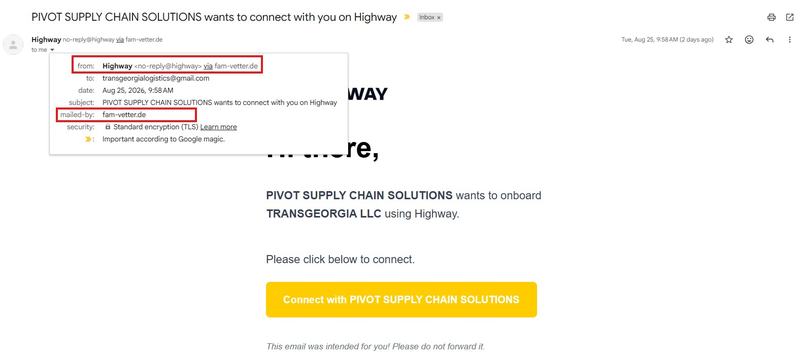
Our second experience was completely different. There was a case when we booked the load from DAT for a bit better price than an average load pays and we received the setup link from RMIS (scam setup link). Had the same case with Highway link as well. Everything looked legit, until it asked us to connect the email.
Twice, unknown individuals used our legitimate company name and MC number to book loads. We discovered this because our company received rate confirmations for loads that had never been booked by any of our employees. Imagine receiving an RC for a load that your dispatch team knows absolutely nothing about.
The company name is yours. The MC number is yours. The information appears legitimate. But nobody in your company booked the load. This is carrier identity theft. We don't know exactly what the individuals behind these attempts intended to do. One possible scenario is cargo theft: a person could book a load using a legitimate carrier's identity, send their own truck and driver to pick up the freight, and then disappear with the cargo.
The consequences can be serious even before the legitimate carrier has done anything wrong. From the broker's perspective, the load was booked under the legitimate carrier's identity. If the truck picks up the freight and disappears, the first company they may contact is the legitimate carrier whose MC number appeared on the paperwork.
That means the legitimate carrier can suddenly find itself having to prove: “We never booked this load.”
This is one of the most disturbing aspects of identity theft in trucking. A carrier can become a suspect in a fraud committed by someone who simply stole its identity.
As soon as we found out someone was trying to steal our identity, we called the brokers who had sent us RCs for loads we never booked and informed them of the situation. We changed passwords for our email and other necessary platforms, informed our partner brokers, and published the information across every social media platform.
How Can Carriers Protect Themselves?
There is no single solution that eliminates freight fraud. The best defense is a combination of verification, internal controls, and constant monitoring.
1. Verify the broker—not just once
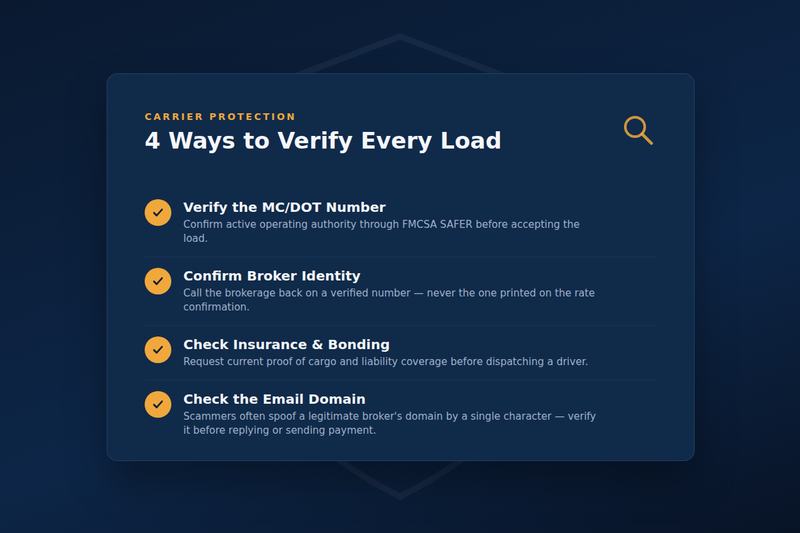
Before accepting a load from a new broker, check their authority, company information, payment history, insurance/bond information, and references where possible. (Brokers also should check the carriers). But don't stop there. A company can be legitimate while a particular transaction is fraudulent. You can call the company number listed on FMCSA to validate the person and the load you booked.
2. Don't rely on one credit or factoring report
A factoring company's information can be extremely useful, but it should be treated as one part of your verification process. Our experience with the $22,000 loss demonstrates why.
The broker appeared legitimate based on the information available to us. That information gave us confidence, but ultimately it did not protect us from the fraud. Use multiple sources whenever something feels unusual.
3. Establish strict internal control over rate confirmations
Every carrier should know exactly who inside the company is authorized to book loads.
If a rate confirmation arrives for a load that nobody on your team booked, investigate it immediately. Don't assume it was sent by mistake. Contact the broker using independently verified contact information and tell them that your company did not book the load.
This can be especially important when dealing with carrier identity theft.
4. Monitor your MC number and company identity
Carriers should think about their company identity the same way they think about their bank account. Don't only monitor whether money is coming in. Monitor whether someone is using your: Company name, MC number, DOT number, Phone number, Email address. If you receive unexpected rate confirmations, load inquiries, or complaints about shipments your company never handled, investigate immediately. It could be a simple administrative error - or it could be evidence that someone is impersonating your company.
5. Verify the email domain 100%
Fraudsters rarely need to hack an account to impersonate a company — they just register a domain that looks almost identical to the real one. A swapped letter, an extra hyphen, a different extension — small enough to miss if you're not looking closely. That's why checking the domain should be routine, not just something you do when a message feels off. The fakes are built specifically not to feel off. Factoring companies can usually confirm a domain in minutes, making this one of the easiest checks to build into your process.
6. Don't let urgency replace verification
Fraudsters benefit from speed: “Driver is waiting.” “Shipper needs the truck immediately.” “Send the RC now.” “Load will be gone in five minutes.” These situations create pressure, and pressure causes people to skip verification steps. A legitimate load can usually survive a few minutes of verification.
What Should You Do If You Discover Identity Theft?
If you receive an RC for a load your company did not book, act immediately. First, contact the broker or shipper using contact information you independently verify—not necessarily the information contained in the suspicious email.
Tell them clearly that:
Your company did not book the load and someone is using your identity.
Then preserve the evidence. Keep: Rate confirmations; Emails; Phone numbers; Screenshots; Names of people involved; Load numbers; Pickup and delivery information; Truck and driver information, if available The faster you create a record showing that your company reported the impersonation, the better positioned you are if the situation develops into a cargo theft or fraud investigation.
Final Thoughts
No carrier can completely eliminate the risk of fraud. But carriers can make themselves much harder targets. Verify new brokers. Use more than one source of information. Question unusual procedures. Control who can book freight under your MC number. Monitor your company identity. Train dispatchers to recognize suspicious communication. And most importantly, don't allow the pressure to move freight quickly to override basic verification.
Our experience taught us that fraud prevention is not about finding one obvious red flag. It's about building a process that makes it difficult for someone to exploit your company's identity, reputation, and trust.
In U.S. trucking, your MC number is part of your business identity. Protect it like you would protect your money.